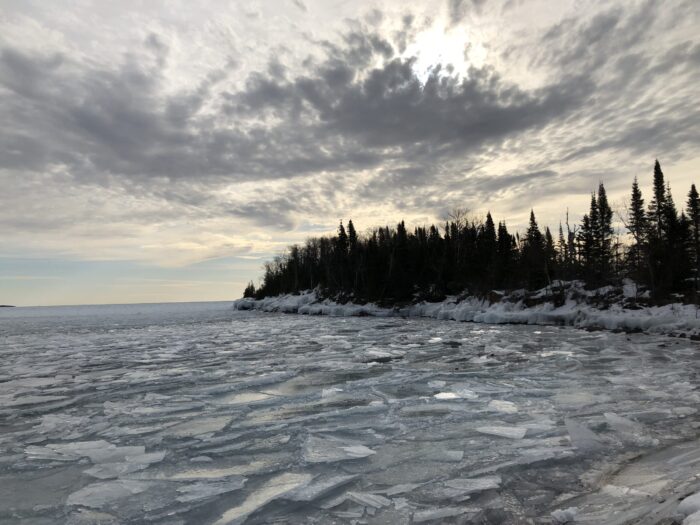
Years of increased winter variability lead to less predictability in lake ice conditions
When Dr. John Downing was growing up, he could count on ice out happening on his local lake the same week every year. Now, he told WTIP, that event has about a seven week window.
Downing is the Director of the Minnesota Sea Grant College Program, a research scientist at the Large Lakes Observatory on Lake Superior, and a professor in the Department of Biology at the University of Minnesota, Duluth. He told WTIP that because lake ice cover is impacted so heavily by weather, and Minnesota’s winter weather has become more variable, so too, has the “ice out” date each year for many lakes across the state.
Lake ice formation and water temperature
Ice formation happens when air temperatures drop below freezing. Downing said, however, that below the ice, water can stay significantly warmer than air temperatures. Once ice has formed, and especially if there is accumulated snow on top, water below is insulated against cold wind and freezing temperatures. While ice may thicken, the lake itself stays warm enough to sustain ecosystems.
Downing said that when he was monitoring water temperatures for an inland lake in the Arrowhead during a recent extreme cold event, the difference between air temperature and water temperature was about 65°F.
Despite the gradual drop in temperatures as fall changes to winter above water, Downing said that lakes retain heat that the water absorbs during the warmer months. “It’s storing really a lot of heat down in the lake, and so that makes a big difference, not only really to how quickly they freeze in the fall, but then also how quickly they thaw in the spring,” Downing said. “The ice will itself basically thaw from above and thaw from below.”
For very deep lakes, the water temperature near the bottom may only change a small amount between summer and winter, but Downing said that nearer the surface, and for shallower lakes, the amount of ice and the duration of the cover, impacts activity in the lake ecosystem. The impacts are not limited to aquatic ecosystems, however. The presence of ice also impacts the lake’s watershed and the surrounding environment.
Impact of lake ice
Prolonged ice cover keeps the temperature around a lake colder. Downing explained that an especially cold or especially warm growth season to start Spring impacts how much and how quickly activity happens in an ecosystem. He added that while many ecosystems have enough resilience to manage individual irregular years, long-term shifts will impact which species continue to live in and around lakes.
According to the National Oceanic and Atmospheric Administration (NOAA) Great Lakes Environmental Research Laboratory (GLERL), while the impact of different periods of ice cover is still being studied, prolonged ice cover could help some spawning fish. For fish seeking colder waters for spawning, the ice acts as a temperature control. For some reef spawning fish, ice could offer protection from wind action caused by waves.
In addition to the ecological impact of ice out variability, Downing said that the increasingly unpredictable season shift impacts human communities and industry. He pointed to the example of businesses dependent on outdoor recreation, saying that planning for those businesses can become difficult.
Ice coverage in 2026
Much of Downing’s research focuses on inland lakes, but he gave an update on lake ice conditions for the Great Lakes. He said the extreme cold throughout the Great Lakes Region in January caused significant ice coverage of all of the lakes, with Lake Erie reaching 95% coverage.
The GLERL tracks data from all five Great Lakes. According to their data, the cold snap in January brought combined ice coverage on the lakes from 5% on January 14, to a combined 51% at the end of the month.
Mild temperatures since then has contributed to a reduction of cover at this point in the year. The current ice cover on each lake is not only lower than the January and early February coverage, but also lower than the averages based on historical data tracking ice throughout winters.
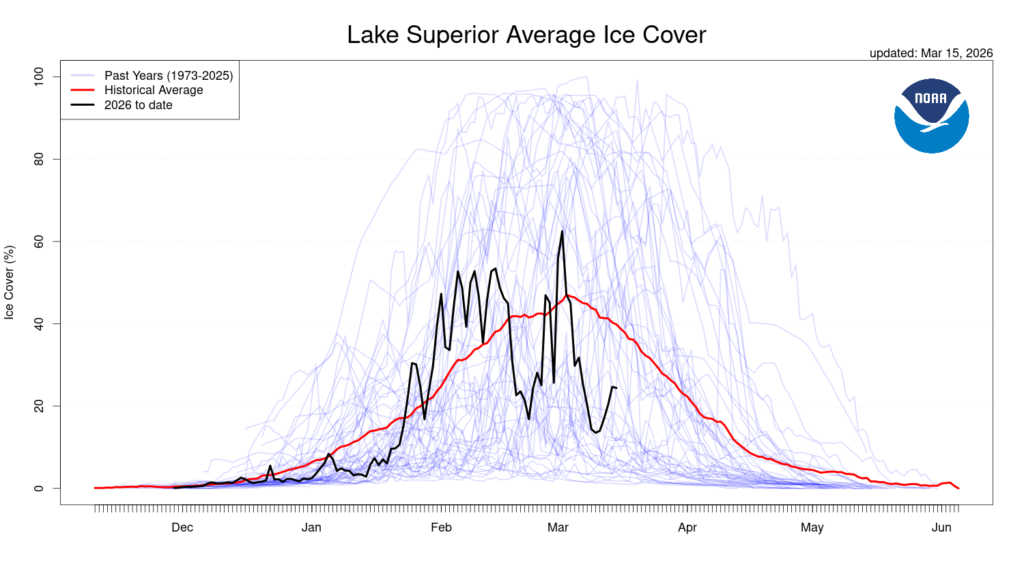
Each of the Great Lakes saw a similar spike in ice coverage at the end of January and heading into February, though the percentage of coverage varied. Second to Lake Erie, coverage on Lake Huron neared 80%. For Lakes Michigan and Ontario, their peak coverage periods hovered close to 40%.
For those who are wondering about their local lakes, and when they might expect ice out, Downing suggested they consult with the Minnesota Sea Grant Thaw Tracker. Based on weather data, the Thaw Tracker forecasts when lakes across the state will reach ice out.
Whether people across the state continue to recreate on ice, or are waiting for ice out, Downing said that ice safety is of utmost importance. He warned that even with milder air temperatures than the coldest points in winter, hypothermia is still a real risk if someone falls through the ice.
WTIP’s Kirsten Wisniewski spoke with Dr. John Downing about lake ice coverage and the current status of the state’s lakes. Audio of that interview is below.
Kirsten Wisniewski March 17, 2026