Collaborative Northern Moose Alliance marks first winter collaring juvenile moose
The first winter of a five-year tribal and state collaborative project to collar and study juvenile moose in northern Minnesota is complete.
Despite encountering numerous days of weather that hindered aerial surveys and collaring efforts, researchers involved in the project were able to collar 60 juvenile moose in a “very small amount of time,” said Seth Moore, the director of natural resources for the Grand Portage Band of Lake Superior Chippewa.
The newly launched project, under the umbrella of the Northern Moose Alliance, is the first of its kind.
“This is the first moose research project that is co-led by state and tribal governments, and I think that is a really powerful statement on the importance of moose to Ojibwe people in Minnesota, but also to the Minnesota citizenry as well,” Moore said.
The Northern Moose Alliance consists of the Grand Portage Band of Lake Superior Chippewa, 1854 Treaty Authority, the Minnesota Department of Natural Resources, with operational and funding support from the National Parks of Lake Superior Foundation (NPLSF).
“Our role in this group is really to pull the voices together,” said Tom Irvine, the director of the NPLSF. The nonprofit organization is also supporting communication efforts, operating a website, and assisting with documenting the 2025-2031 research project. Irvine said the organization is also funding Adam Mortensen, a moose biologist assigned to the project who is living in Grand Marais.
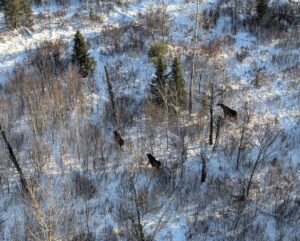
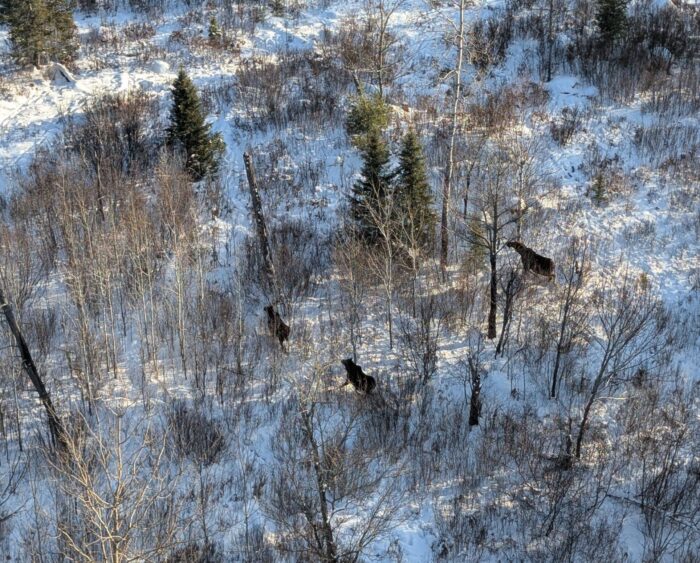
Aerial Survey of Cow with Twins | Morgan Swingen, 1854 Treaty Authority
While past research has focused on young calves or adult moose, Morgan Swingen, a wildlife biologist with the 1854 Treaty Authority, said the main goals of the project are to assess the survival of juvenile moose, particularly at what age female moose become reproductive adults.
Swingen, along with other researchers involved in the project, says the current gap in moose research that this project will address focuses on “teenage moose.”
“We don’t know how many yearlings or two-year-old females are reproducing,” Swingen said. “We just don’t have a lot of data there.”
To study this, researchers collared juvenile moose aged 8 months to 3 years this winter, allowing for monitoring of survival. Each winter for the remainder of the project, researchers will collar between 60 and 80 juvenile moose.
Furthermore, Swingen said, “We’ll be looking at progesterone and fecal pellets of females to determine pregnancy.”
The research will provide state and tribal officials with insights into the drivers of population growth.
“I think one of the things that we recognize is the population has stabilized over the past decade or so, and while that’s a good thing that it’s not declining further, it’s not also growing,” said Michelle Carstensen, the Minnesota DNR wildlife health program supervisor.
The DNR recently released its 2026 moose survey results, which showed a slight increase in population but are still well below levels over a decade ago. The current population is estimated at approximately 4,470 animals.
“Helping to increase the herd growth is important to us,” Carstensen said. “And trying to identify if we find limitations in recruitment.”
The research project will also provide insights into moose productivity within their habitats, guiding future forest management efforts to grow the population.
While researchers have wrapped up the first winter of the project, the next phase will begin this week.
On April 2, officials with the Northern Moose Alliance will launch a website and a citizen-science component of the research project. The citizen-science effort will entail soliciting trail camera photos of moose throughout the Arrowhead region to document the effect of winter ticks on survival. The website will serve as an educational hub for the public to follow the multi-year research project, attend webinars, and interact with “all things moose-alliance related,” said Irvine.
WTIP’s Kalli Hawkins spoke with Seth Moore, Morgan Swingen, Michelle Carstensen, and Tom Irvine in a special 30-minute program about the newly formed tribal-state collaborative research project under the umbrella of the Northern Moose Alliance.
The audio includes a discussion of field observations this winter, moose populations in northern Minnesota, factors influencing moose mortality, calf recruitment, the geographic scope of the research, and much more.
Kalli Hawkins March 30, 2026