Proposed off-highway vehicle bill sparks debate over trail access and environmental protections
Lawmakers, advocates, state and tribal officials, and industry representatives weighed in on proposed legislation that would impact off-highway vehicle (OHV) access and trail use during a Thursday hearing at the Capitol.
Minnesota Senate Environment, Climate, and Legacy Committee members heard testimony spanning a wide range of perspectives, with supporters of SF1245 arguing the measure would create consistency in OHV rules statewide and protect sensitive environmental areas, while opponents raised questions about its broader impacts and language in the bill that could restrict or eliminate OHV access.
The bill’s author, Senator Jennifer McEwen (DLF-Duluth), said during the March 26 hearing, that the bill would, “enact trail management practices that would better protect and preserve our current ATV trails, as well as our beautiful lakes, streams, and wildlife habitat on the public lands that belong to all Minnesotans.”
McEwen said the five primary objectives of the bill are:
- It would make state law regarding OHVs consistent throughout the state, with access to designated and posted trails.
- Create buffer zones that codify the Minnesota Department of Natural Resources and the U.S. Forest Service’s guidelines for water protection. The bill would prohibit OHVs on unpaved roads within 200 feet of public waterways that support aquatic life. It would also prohibit OHVs on an unpaved road within 150 feet of a public water body that does not support aquatic life.
- Implement a 2023 legislative audit recommendation requiring environmental assessment worksheets (EAW) for future trail development.
- The bill lays out a process for gathering tribal approval and local input early in the trail planning process.
- Provides a trail decommissioning process that would allow local citizens, if they have material evidence of environmental harm occurring, to petition the DNR for consideration of decommissioning the OHV trail. The bill states that a minimum of 50 individuals who reside in or own property in the county where the road or trail is located can petition. A minimum of 150 individuals who reside or own property in Minnesota can petition.
As a northeast Minnesota resident and “Duluth gal,” McEwen said on Thursday that she likes ATVing and that the intent of this bill is to “clarify for all of us in the Northwoods to make it fairer.”
She said, “So that we know where ATVs go and where to have fun doing that. And we also make sure that we’re not destroying wetlands. We’re not making it hard for other people who like to enjoy the woods.”
Testimony was heard from opponents of the bill, including Dr. Laura Preus, the Minnesota DNR statewide programs and planning manager of the parks and trails division. Preus spoke about the existing OHV designation process, which includes the steps taken before an OHV grant-made trail is designated. The steps include tribal review and consultation, environmental review, and a public review process, she said.
It is “an extensive process, and this bill changes this in the sense that it adds many, many more extensive restrictions to OHV trails as well as changes the environmental review process in ways that are different than other types of trails,” Preus said.
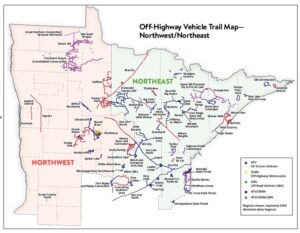
Off-highway vehicle trail map | Contributed by Minnesota DNR
In December 2025, the Minnesota DNR finalized the OHV master plan, which outlines how the DNR manages trails, the grant-in-aid program, and more. Currently, over 90 trails in Minnesota receive grant-in-aid funding from the DNR. Local volunteer clubs, such as the Cook County ATV Club, use the funding to maintain the trails. The grant-in-aid program requires that all new trails go through a 7-step review process.
Other testimony from opponents of the bill included Ron Potter, president of ATV Minnesota. Potter said the bill “Threatens the responsible trail framework that we’ve worked decades to establish.”
Senator Grant Hauschild, who represents northeastern Minnesota, spoke in opposition to the bill.
“This bill is not a small change. It’s a fundamental shift in how access works across the Northland,” Hauschild said.
Hauschild said he has concerns about the practical implementation of the proposal, including the lack of dedicated funding for mapping, signage, and enforcement.
Furthermore, he said, “Northern Minnesota is different, and our policies need to reflect that. This bill takes a system that works on the ground and replaces it with one that risks shutting down access, creating confusion, and slowing down trail development across the region.”
In northern Minnesota, the Voyageur County ATV club also opposes the bill, stating that it would move the region toward a designated trail-only system, limiting access to lands that have historically been open and responsibly used by the public.
Testimony from supporters of the bill included Kelly Applegate with the Mille Lacs Band of Ojibwe, who spoke about environmental harms to “manoomin,” or wild rice.
Retired DNR officials and several environmental advocates spoke in favor of the bill. Greg Kvale of Minnesota Backcountry Hunters and Anglers said the organization supports one specific measure of the bill: access to designated and mapped trails. Kvale said the organization supports unifying OHV rules across the state.
Included in support for the bill was a letter from the Cook County Coalition of Lake Associations (CCCoLA), which represents 19 lake and road associations in the county. The letter stated that the CCCoLA Board members strongly supported the bill and that the provisions in the bill are “vital to ensuring a balance of recreational opportunities with protections for sensitive wilderness environments.”
After hearing testimony, Committee Chair and Senator Foung Hawj (DFL-St. Paul) said it was clear that more discussion about the bill would be needed.
The bill’s author, Sen. McEwen, agreed and said she would like to reach some consensus and “middle ground” with those who opposed the bill. The bill was laid over for consideration.
Kalli Hawkins March 27, 2026