New fish consumption guidelines in northeast Minnesota aim to limit exposure to mercury and PFAS
The Minnesota Department of Health released its updated fish consumption guidelines this week regarding mercury and per- and polyfluoroalkyl substances (PFAS).
The updates include new length-based guidelines for walleye and northern pike, increased protective guidelines for northeastern Minnesota, and new guidelines for the Vermillion River in Dakota and Scott counties.
“Generally speaking, fish are a good part of a healthy diet,” said Angela Preimesberger, MDH’s fish consumption guidance program lead. “Fish can be a source of important omega-3 fatty acids, which help with heart health and brain function. However, based on our analyses, we advise limiting how many servings of certain fish you eat from certain locations.”
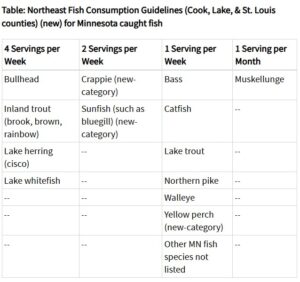
The Minnesota Department of Health (MDH) regularly collects data on fish contaminants to inform guidelines. The newly updated northeast fish consumption guidelines follow the statewide guidelines, except for five species, for which average mercury levels in fish from select waterbodies in Cook, Lake, and St. Louis counties were higher.
The updated northeast fish consumption guidelines for the general population: people not planning to become pregnant; boys and men age 15 and older, not to exceed, are below:
The updated northeast fish consumption guidelines for sensitive populations: children under age 15; girls, women, and people age 15 and older who may become pregnant, people who are pregnant, people who are breastfeeding or plan to breastfeed, not to exceed, are below: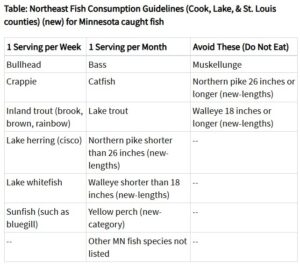
The MDH lists the specific rivers, creeks, and streams included in the updated March 2026 guidelines, which span the state. In the northeastern region, several rivers in St. Louis County have updated fish consumption guidelines. The Beaver River in St. Louis County recommends minimal consumption of all species, as many are contaminated with PFAS.
On the Lester River, MDH officials found mercury contamination in rainbow trout of all sizes and recommend limiting consumption to twice a week. Farther north in Koochiching County, crappie of all sizes were found to contain mercury, and the MDH recommends limiting consumption to twice a week for the general population. Find the full MDH waterbody-specific guidelines for rivers here.
MDH officials say mercury remains a concern throughout the state, particularly in northeast Minnesota.
“Certain industrial processes emit mercury into the air, which then settles in water and accumulates in fish,” MDH officials said. “If people regularly eat fish with elevated mercury, the mercury can damage their kidneys, liver, and nervous system. It can also impact understanding and learning in young children.”
MDH’s fish consumption guidance program works with other programs within the DNR and the Minnesota Pollution Control Agency (MPCA) to select lakes and rivers for contaminant monitoring.
Several lakes and rivers in Cook County are listed on the MPCA impaired waters list for mercury contamination, including the Brule River, Devil Track Lake, Two Island, Greenwood, Pine, Elbow, and several others.
For specific lakes, MDH recommends following the fish consumption guidelines listed on the Minnesota Department of Natural Resources (DNR) LakeFinder. Not all waterbodies in Minnesota have been tested for contaminants in fish.
For Lake Superior fish consumption, MDH recommends the following for the general population: people not planning to become pregnant; boys and men age 15 and older, not to exceed: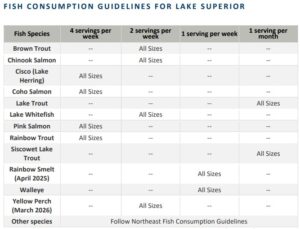
For Lake Superior fish consumption, MDH recommends the following for sensitive populations: children under age 15; girls, women, and people age 15 and older who may become pregnant, people who are pregnant, people who are breastfeeding or plan to breastfeed, not to exceed: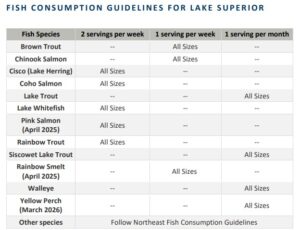
For the past few years, MDH has issued fish consumption guidelines related to PFAS in fish from the Mississippi River and other Minnesota waterbodies. This year, MDH added the Vermillion River from headwater streams in Scott and Dakota counties.
PFAS are human-made chemicals that do not break down over time and have been widely used for decades to make products that resist heat, oil, stains, grease, and water. PFAS may accumulate in a person’s body over time and may become a health concern. They are linked to developmental effects, including low birth weight in infants and a weaker immune system in children. Exposure to some PFAS may also cause changes in liver function and increase cancer risks.
Additional information about mercury and health can be found on MDH’s website: Contaminants and Minnesota Fish.
Listen to an archived WTIP-produced Lake Superior Project feature about mercury and fish consumption here.
Kalli Hawkins March 29, 2026