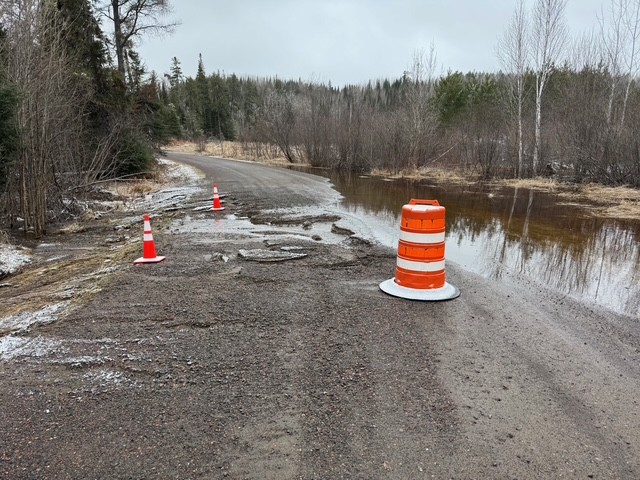
Sink holes and washouts are part of spring road hazards
While the storm that blew across the North Shore on Friday, April 17, was brief, it was just intense enough to open several sinkholes on roads in Cook County. Highway Maintenance Superintendent Matt Nesheim told WTIP that while these were not the type of sinkholes that would swallow a car, they did make roads impassable, and, unfortunately, they are the type of damage his department often sees during the spring thaw.
The sinkholes Nesheim said his department sees are most commonly caused by water being unable to pass through a culvert, and instead carving out the dirt just below the compacted surface of the road. He said that at this time of the year, frozen culverts are a common culprit.
Though Friday’s rain was not a significant amount on its own, coupled with the snowmelt of the days prior meant a lot of water without a place to go. Nesheim said that sinkholes can form rapidly, and can be difficult to detect until a car breaks through the road surface above the cavity. In the event that the damage is significant, highway department crews close and repair the road right away, like they did this past weekend.
Nesheim said that the best thing is to try to get ahead of sinkholes and the subsequent washouts, which can span the whole width of a road, by grading roads with drainage in mind, keeping ditches as clear as possible, and monitoring culverts.
Another common road condition that can arise in the spring is “washboarding,” where the binder in the aggregate mix that makes up the road separates, and as vehicles drive on them, the texture of the road becomes a series of ridges.
Nesheim said that a major part of how his department addresses washboarding is by grading roads, but to do that, the weather has to be a little warmer. Frost is an obstacle for addressing springtime issues, so until the frost has left the roads, Nesheim asked the community for understanding. He said that as soon as the conditions are right, his crews will be out addressing potholes and washboarding, in addition to smaller washouts.
While he could not give a specific date that maintenance work will begin on county roads, since it is weather-dependent, he said that his department is preparing to spread roughly 20,000 cubic yards of gravel on county roads. The most trafficked roads will also be treated with calcium chloride to help control dust.
Another spring hazard that impacts roads is downed trees. Nesheim told WTIP that as the ground thaws and softens, falling trees becomes more common.
Nesheim said that county residents can play their part in preserving the county roads by not speeding on gravel roads. He added that as work begins, drivers should keep an eye out for crews.
For any road-related questions or reports of damage, drivers can contact the Highway Department at 218-387-3014, or through their online submission form. Urgent after-hours reports can be made to the Cook County Sheriff at 218-387-3030.
WTIP’s Kirsten Wisniewski spoke with Maintenance Superintendent Matt Nesheim live on Daybreak. Audio of that interview is below.
Kirsten Wisniewski April 21, 2026