City adopts urban forest management plan to guide future tree initiatives
Since 2024, the City of Grand Marais has been developing an urban forest management plan to guide the city in implementing goals and best management practices for the care, preservation, planting, and removal of trees and shrubs within city limits.
The initiative was made possible through a Minnesota Department of Natural Resources ReLeaf grant, which provided municipalities with funding to conduct a city-wide tree inventory and develop an urban forest management plan. The City of Grand Marais was awarded ReLeaf grant funding in 2024 and, shortly thereafter, formed a City Tree Board to carry out the project.
The tree board members worked with the company Emmons & Olivier Resources, Inc. (EOR), a St. Paul-based engineering and environmental firm, to conduct a tree inventory and assist in writing the plan.
During the Feb. 11 city council meeting, Sustainability Coordinator Shane Steele presented the findings of the city-wide tree inventory and a final draft of the urban forest management plan.
In total, 50 species of trees were identified in Grand Marais, with the most common species being white spruce, red pine, paper birch, quaking aspen, and sugar maple.
The inventory also assessed tree health and identified conflicts between trees and structures on public and private property. The findings showed:
- 90% of the trees in Grand Marais are in good health
- 20% of all trees were spruce
- 87% of the spruce trees showed signs of spruce budworm defoliation
- 84 conflicts were identified between trees and structures, with 50% of those involving overhead wires
“The inventory found that some of the trees in our downtown area are needing a little more maintenance,” said Steele.
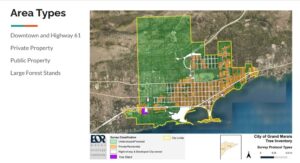
Graphic of area types included in the city-wide tree inventory
After reviewing the tree inventory findings and the final draft of the management plan, the city council unanimously approved the plan during the Feb. 11 meeting.
Steele said that now that the plan has been adopted, the city will continue to seek additional grant funding to carry out the initiatives outlined in the plan. Projects would include removing problematic trees and planting native trees that are more resilient and not susceptible to spruce budworm defoliation.
One of the hurdles to implementing the identified projects is the cost of planting and maintenance, Steele said. The plan outlines scenarios of tree planting and removal that could cost tens of thousands of dollars a year, with a 10-year projected cost in the hundreds of thousands.
Steele said the intent right now is not to spend city taxpayer funds, but instead seek additional DNR grant funding to carry out the projects. If the city secured funding, it could potentially help homeowners with tree removal costs. “The funding would help you remove that tree, and then we could plant a few trees in your yard in its place.”
Steele said the long-term goal of the urban forest management plan is to increase the forest canopy in Grand Marais by 10%. To achieve this goal, the city would need to plant 200 trees per year, mostly in residential areas. Other goals include planting at least 25 new trees in the Downtown/Hwy 61 area and increasing the diversity of the city’s urban forest.
WTIP’s Kalli Hawkins spoke with City Sustainability Coordinator Shane Steele about the adoption of the urban forest management plan and the city’s short- and long-term goals. Audio is below.
Kalli Hawkins March 7, 2026