Forest Service to relocate headquarters to Utah, close research sites including two in northern Minnesota
President Donald Trump’s administration will move the U.S. Forest Service headquarters out of the nation’s capital to Salt Lake City as part of an organizational overhaul that involves shuttering research facilities in 31 states and concentrating resources in the West, the agency announced this week.
Agriculture Secretary Brooke Rollins said the move, which is expected to be completed by summer 2027, will bring leaders closer to the landscapes they manage and the people who depend on them.
“This is about building a Forest Service that is nimble, efficient, effective, and closer to the forests and communities it serves,” said Forest Service Chief Tom Schultz.
With the move to Utah, about 260 Forest Service positions currently located in Washington are expected to relocate, and 130 workers will stay put, the agency said.
Alongside the relocation of its headquarters, the Forest Service will begin transitioning to a state-based organizational model that shifts authority closer to the field by organizing leadership around state-level accountability.
Under the new model, 15 state directors will be distributed throughout the country to oversee Forest Service operations within one or more states. The agency said state directors will serve as national leaders with primary oversight of forest supervisors, operational priorities, and relationships with states, tribes, and other partners.
Many regional offices will close in the reorganization, and their services will shift to hubs in New Mexico, Georgia, Colorado, Wisconsin, Montana, and California.
The Forest Service said it did not yet know how many workers in regional offices would need to relocate.
As for regional offices in Minnesota, particularly the northern part of the state, a Superior National Forest spokesperson told WTIP that the Tuesday announcement included, “no changes for forest or district offices or their staffing. The Superior National Forest is committed to ensuring that all operations — including wildfire readiness and response — continue without interruption.”
As part of the reorganization effort, however, several research and development facilities will close across the U.S., including two in northern Minnesota. A facility in Grand Rapids and in Ely will close over the coming year.
The long-standing Grand Rapids research facility set to close has studied how climate change will impact forests and wetlands, as reported by Grand Rapids based radio station KAXE. The research station has been apart of the Minnesota North College-Itasca campus and employs 10 Forest Service personnel.
The Forest Service has not provided additional information at this time about which research facility in Ely will close.
Other facilities scheduled to close in the Midwest include Prairie du Chien and Wisconsin Rapids in Wisconsin. In Michigan, four research and development facilities will close.
Despite the restructuring, the Forest Service said operations and personnel within the fire and aviation management program, as well as its field-based operational firefighters, would not be impacted.
That includes within the Superior National Forest, the spokesperson told WTIP. “The Forest Service’s fire readiness and response remain unchanged, and our operational firefighters and aviation resources continue to support wildfire response.”
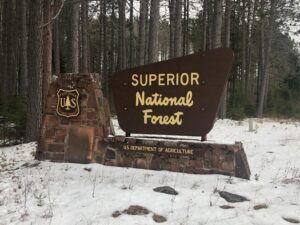
Superior National Forest Sign | Photo by Kalli Hawkins
During his first term, Trump moved the Bureau of Land Management to Colorado, citing many of the same reasons, including a desire to put top officials closer to the public lands they oversee. But it wasn’t long before the Biden administration reversed course, moving BLM headquarters back to Washington, D.C., after two years.
The U.S. Department of Agriculture has been moving thousands of employees out of Washington over the past year and eliminating layers of management as part of Trump’s push to slim down the federal workforce and make it more efficient.
Utah Gov. Spencer Cox, a Republican, celebrated the move Tuesday as “a big win for Utah and the West,” while environmental groups viewed it as a precursor to the agency’s dismantling.
Josh Hicks, conservation campaigns director at The Wilderness Society, predicted that the move will lead to less access to public forests and threats to wildlife habitat, clean water, and air.
“At a time when wildfires are getting worse, and access to public lands is already under strain, the last thing we need is an unnecessary reorganization that creates chaos and confusion for the land managers, researchers, and wildland firefighters who help keep our forests healthy now and for future generations,” he said.
The Wilderness Society also pointed to Trump’s prior attempt with the BLM, saying that resulted in many staffers leaving who had valuable years of management experience. The group said this could end up hollowing out the Forest Service.
Public lands have been in the spotlight during the Trump administration, with the rescinded roadless rule, protected areas within Alaska opened for industrial use, and repeated efforts by Utah lawmakers to sell public lands.
In 2024, Utah filed a public lands lawsuit seeking control over 18.5 million acres of land. The Supreme Court denied hearing the case, and the lawsuit failed.
In June 2025, a budget proposal from Utah Republican Sen. Mike Lee intended to sell more than 3,100 square miles of federal lands to the state or other entities. It was included in a draft provision of the GOP’s sweeping tax cut package.
Lee said the intent of the federal land sales under his proposal would target “isolated parcels” that could be used for housing or infrastructure and would not include national parks, national monuments, or wilderness areas. Land in 11 Western states from Alaska to New Mexico would have been eligible for sale.
The Associated Press contributed to this report.
Kalli Hawkins April 4, 2026