


Trail Time – Shoulder Season on the Gunflint Trail
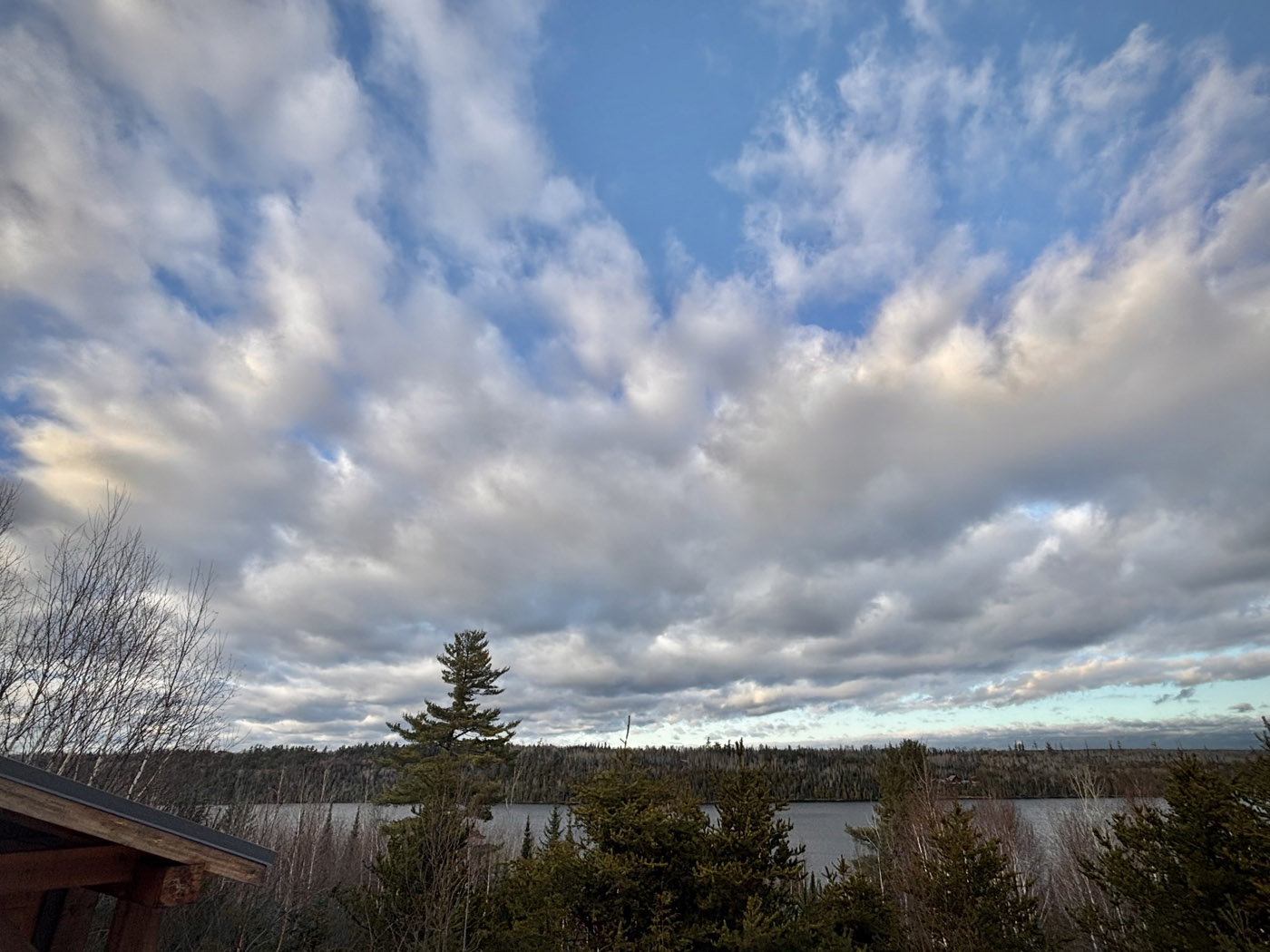
It’s the shoulder season here on the Gunflint Trail which means it’s one of the quietest times of the year. There’s not much snow yet — the three or so inches from last week are melting and turning our paths and roadways into ice. The skies have been low and gray all week but I can see north of Gunflint Lake today and there are clear blue patches of sky in between the fast moving heavy clouds of yellow, pink, purple and dark blue. We usually get a visit by the sun at least once a day when it lights up the shore across the lake. We live on the dark side of the lake, but we get a beautiful display when the rising or setting sun strafes the far shore with light. Suddenly the green of the conifers deepens, the silver aspens glow with their own light and the white birch stand in stark contrast to their neighbors, their red twigs forming soft mauve domes across the distance. The cloud watching is and has been has been stupendous.
We saw a very healthy-looking wolf last week trotting down the Trail and as it turned down a gravel road, it stopped briefly to leave a message on a brush pile and then, turning its head, looked at us like, are you talking to me? They always appear so unimpressed by human presence. They are so sure of themselves in this, their natural habitat, up here in the northwoods. I love seeing them and all our wild neighbors. Every sighting of moose, bear or wolf (or fox, or lynx, etc., etc.) fills me with gratitude that I live in such a beautiful place — so rich in wild things. When we saw big wolf prints yesterday by our cabin, however, I felt the balance shift from that of wonder to that of protecting our dog. And that’s just a reality of living where we do. Keeping pets safe is part of living with wild neighbors — the bear, moose, and wolves of the northern forests. So at the same time we love the sightings of wild creatures, it means added vigilance when our dog is outside with us.
We probably don’t have to worry about bears any more this year —
The local bear population is mostly in hibernation now, just entering into that fascinating state of low metabolism, where bears live off their stored fat and don’t eat, drink or defecate for five to seven months. Oh yes, they also give birth during this time, to the tiniest little blind and hairless cubs which are born in the den then crawl their way to their mothers nipples for sustenance. Sleep well, bruins.
Moose roam all winter, eating twigs and avoiding wolves. One winter, a photographer friend was staying at Gunflint Lodge and I stopped by to pick her up. Armed with her camera and her well-behaved dog , we went to search for moose so she could shoot some photos. I started driving us down the Trail, took a turn and in a few minutes voila, there she was, a nice big cow moose, calmly eating twigs standing in the deep snow drifts by the side of the road. We stayed in the truck there for about 500 exposures, I think. Moose are at their most dangerous to humans and dogs during the rut or when cows are defending calves. I felt quite safe in the truck, in the winter. Moose in our area went through a decline a while ago, but for the last decade the population appears to be stable, with around 4,000 in our northeastern corner. of the state. Moose numbers are affected by parasites (including brainworm and winter ticks), habitat changes, and predation. Their main predator? Wolves.
The wolf population in The Superior National Forest numbers around 300-400 roaming over an area of 50,000 acres within the forest. Twenty to thirty wolves in eight to fourteen packs are monitored each year. Lars and I see them — when we see them — usually on a lake or on the Gunflint Trail or side roads, where they can be seen from a distance. Once the lakes freeze, a whole new world opens up to all the mammals who search for their daily food, and for us who search for a sighting of these big beautiful animals, here on the Gunflint Trail.
— Marcia Roepke


