Researchers see similar trend of declining moose in Isle Royale’s winter survey
Researchers recently completed the 2026 winter wolf and moose surveys at Isle Royale National Park, and initial survey observations indicate a trend similar to that observed in recent years.
“It was no real surprise,” said Dr. Rolf Peterson, one of the researchers from Michigan Technological University involved in the annual surveys. Peterson has been studying moose and wolves for several decades at Isle Royale, located 22 miles across Lake Superior from Grand Portage.
Peterson said observations from this winter’s survey indicate that moose populations are low and wolf populations are high.
“That’s the way it’s been for several years,” Peterson said. “And that’s probably going to continue.”
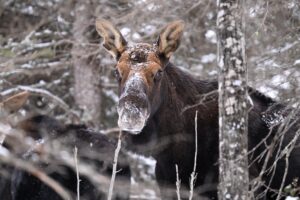
Moose on Isle Royale National Park | Contributed by Wolf-Moose Project
Moose populations have been declining since approximately 2010, when the population peaked at an estimated 2,000. By 2023, the population had fallen to 967, a 22% decrease from the previous year.
The latest population estimate was 840 in 2024. The 2025 winter survey was unable to be completed due to an unexpected medical issue with the pilot involved in the aerial surveys.
Peterson said with the continued downward trend of moose populations, “Moose are hitting a low level that we haven’t seen or probably only seen once before in the last half century.”
Over a quarter century ago, in 1999, the moose population on the island was 750, according to the annual wolf-moose survey reports.
Peterson said when the population was at its peak at roughly 2,000 moose, it was having “quite a negative, dramatic effect on the forest.”
Moose were browsing on the vegetation and balsam fir and consuming enough that “forest regeneration just wasn’t happening at all,” Peterson said.
The overbrowsing of vegetation led researchers to begin reintroducing a small number of wolves in 2018. Since then, through predation, the wolves have reduced the moose population.
Wolf populations on the island have hovered between 28 and 31 since 2022.
Peterson said he was pretty impressed during this year’s aerial surveys to see a “pretty high kill rate of moose by wolves.” He said there was no obvious evidence that wolves were experiencing a shortage of food.
One of the unique observations from the 2026 winter survey was the formation of an ice bridge between Isle Royale and the mainland near Grand Portage and Thunder Bay, Ontario. In late January, Peterson said the ice bridge formed, and “It stayed pretty solid for three, four weeks.”
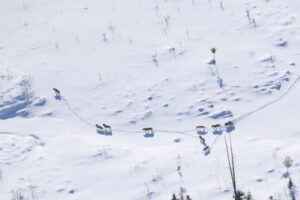
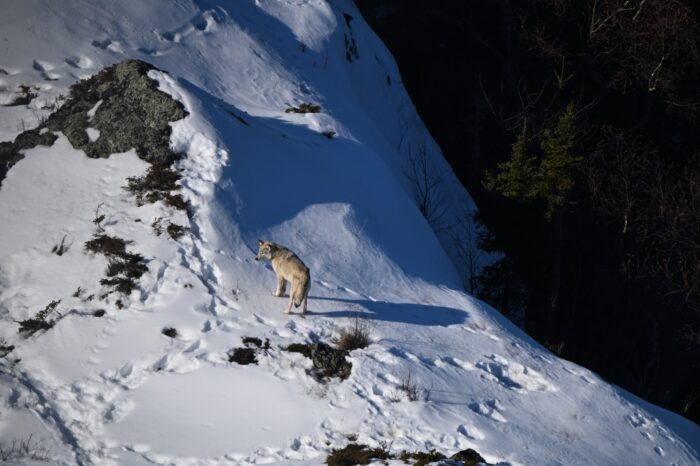
Wolves seen at Isle Royale during aerial survey | Contributed by Wolf-Moose Project
He said an ice bridge to the mainland is something that researchers haven’t witnessed for more than a decade.
Researchers did not observe any wolves traveling across the ice bridge this winter, but Peterson said it is possible. Each year, researchers collect and study wolf scat on the island. He said time will tell whether DNA from a new wolf that walked across the ice bridge from the mainland is present.
“That takes, sometimes, years before you fully realize there was a wolf that came into the system,” Peterson said.
While the winter wolf and moose surveys are complete, researchers will spend the next two months compiling the data. The annual report, which includes the estimated wolf and moose population numbers is expected to be published in May.
WTIP’s Kalli Hawkins spoke with Dr. Rolf Peterson about the 2026 wolf and moose survey at Isle Royale National Park. The audio is below.
Kalli Hawkins March 13, 2026