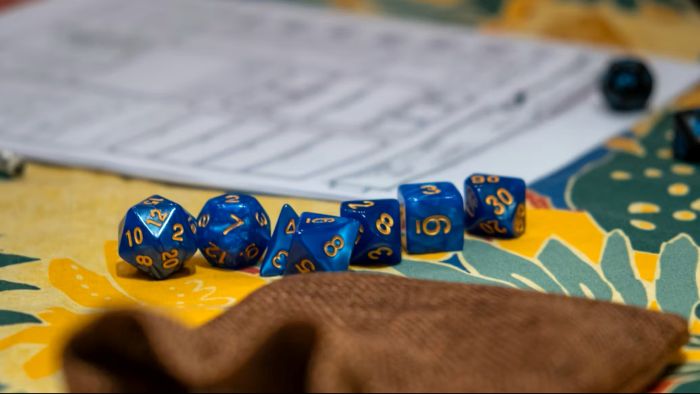
Dungeons & Dragons program creates space for youth, adult imagination
A handful of boys buzz with energy at the end of the school day, passing around an iPad while waiting for their biweekly game of Dungeons & Dragons to begin.
Ty Kundel runs the game through Cook County Community Education, with a Thursday session for school-age players and a Saturday session for adults.
“It grew very rapidly, I would say, even unexpectedly,” Kundel told WTIP. “A lot more folks signed up, I think, than anyone anticipated.”
While Dungeons & Dragons can be played with varying group sizes, most tables include four to six players. Kundel’s youth group has seven players, while the adult group has nine.
First published in the 1970s, the tabletop role-playing game has seen waves of popularity. It surged in the 1980s before a combination of cultural backlash and business challenges pushed it into a more niche space.
Interest rebounded in the mid-2010s, driven in part by the release of the game’s fifth edition in 2014 and the rise of live-play shows such as “Critical Role.” Appearances in movies and television have further expanded its reach.
Kundel said his own experience with the game mirrors those broader trends.
“So it goes way back for me, back when it was pretty much mimeographed pamphlets — late ’70s, 1980, somewhere in there,” he said. “A friend of mine had what was essentially a photocopy of the rules, and he’d heard about it through one of his friends who had an older brother.”
Kundel stepped away from the game while focusing on his career and raising children, but returned after the release of the latest edition.
He said many new players come to the game with a background in fantasy literature.
“Most folks are familiar — who come into playing — with some sort of fantasy literature. And I think that’s where it begins with most folks,” Kundel said. “I think it tends to attract a more creative mind, someone who is willing to use their imagination.”
Kundel tailors his sessions to different audiences. Games for middle- and high-school students emphasize action, while the adult group explores more complex themes and world-building.
“Rule one is, we’re here to have fun, and that’s exactly what we’re doing,” Kundel said. “You can see the kids mature and develop in their approach to problem solving and interaction with each other, that’s a lot of fun. And then with the adults, the older crew, it’s been a lot of fun just to be able to develop a world, throw a set of problems at them, and watch them nug through it.”
WTIP spoke with Kundel about his work with Cook County Community Education and how to get started with the game. Audio of that conversation is available below.
Josh Hinke April 25, 2026