July wildfires contributed to $9.4 million decline in Cook County business sales, survey finds
For Cook County businesses, the July wildfires across northern Minnesota hit during the height of the summer tourism season, when businesses rely on a steady flow of visitors and revenue.
A new survey estimates the fires, smoke, and related closures contributed to a $9.4 million decline in total sales compared with July 2025.
The Cook County Chamber of Commerce, Visit Cook County, Cook County Economic Development Authority, and Cook County officials partnered on the survey to measure the economic impact of the July wildfire activity. More than a dozen wildfires were reported across northern Minnesota in early July following a lightning event. Several fires also burned across the border in Canada, including the Little Knife Fire, which crossed into the U.S. near the end of the Gunflint Trail.
The survey received 140 responses from businesses across the county in sectors such as lodging, camping, outfitting, dining, retail, and others.
“I think we all knew that our outfitters were suffering; we knew that the Boundary Waters was closed,” said Chamber of Commerce Executive Director Linda Jurek.
But Jurek said county officials wanted to understand the broader economic impact — including temporary business closures and the longer-lasting effects of poor air quality and wildfire perceptions. While the heaviest smoke conditions lasted only a few days, its impact on tourism continued for weeks.
The survey found that across all sectors, businesses reported an average 34% decrease in revenue in July compared with July 2025. Outfitting businesses reported the largest average decline at 52%, followed by retail at 31%, lodging and camping at 29%, dining at 27%, and other at 34%.
Jurek said the estimated $9.4 million decline in total sales was calculated using July 2025 lodging and sales tax data and applying the average percentage decreases reported by businesses. The survey estimates a $2.4 million decrease in lodging sales alone.
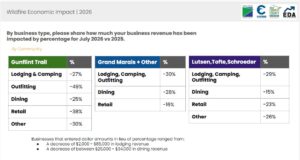
Graphic of Economic Impact of 2026 Wildfires & Closures
While the data confirmed that outfitters up the Gunflint Trail and Sawbill Trail experienced the greatest economic impact, it also showed that businesses in other parts of the county, like Grand Marais, Lutsen, Tofte, and Schroeder, experienced financial losses.
The survey also indicates the economic effects continued well beyond July.
Sixty-three respondents indicated that August and September bookings have been impacted, with 32% stating the cancellation rate is at least 25% or greater. Because of Boundary Waters Canoe Area Wilderness closures, smoke conditions, and cancellations, 35% of respondents said they reduced employee hours or staffing levels.
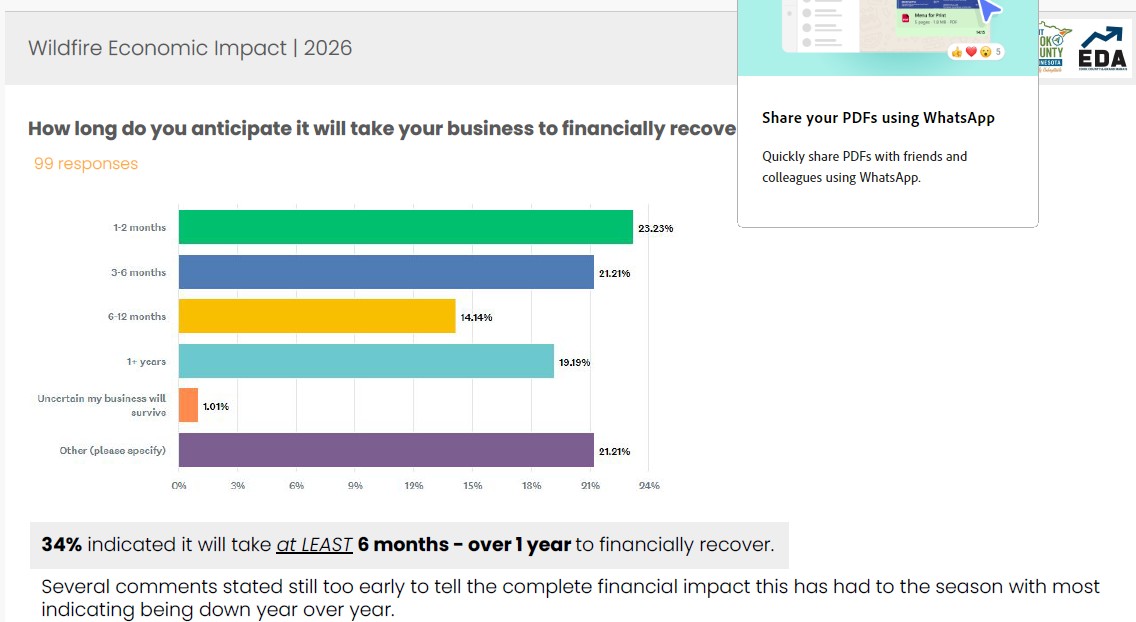
Graphic of Economic Impact of 2026 Wildfires & Closures
On recovery, 34% of respondents said they expect it will take at least six months to more than a year to recover financially.
Jurek said the survey results are being used to advocate for state financial assistance. The Chamber of Commerce is working with state Sen. Grant Hauschild and Rep. Roger Skraba on a bill that could provide assistance to businesses affected by the wildfire impacts. Hauschild and Skraba held a roundtable discussion regarding the economic impacts alongside other agencies and state representatives in Cook County on July 31 at Hungry Jack Lodge.
The survey data has also been shared with Gov. Tim Walz and other state leaders to demonstrate the need for a special session before the end of the year.
“Hopefully we can turn that around and get something done before the end of 2026,” Jurek said. Gov. Tim Walz said earlier this month that a special session is unlikely this year and would be a “pretty heavy political lift at this point”, citing the ongoing election season.
The survey found that Cook County businesses identified financial relief, including tax reductions, low-interest loans and grants, as among the most beneficial forms of assistance at this time. Respondents also called for increased marketing and public relations efforts to counter concerns about wildfire danger and air quality.
While the worst air quality lasted only two or three days, Jurek said media coverage and public perceptions of the wildfire conditions created a longer-lasting impact on businesses.
“There was a lot of twist in the media on that smoke, dramatizing what was really occurring,” Jurek said. She acknowledged that conditions were truly bad for several days, “I’m not negating that” — but said the messaging and public perception continued even after conditions improved. The Chamber of Commerce and several outfitters continue to receive phone calls in mid-August from visitors asking what the danger is with the wildfires and current air quality conditions.
Cook County businesses are among many others across northern Minnesota that have experienced financial impacts from the wildfires, smoke, and related closures. Earlier this month, 82 businesses and nonprofits signed a letter sent to Gov. Walz and the Minnesota Legislature, calling on state leaders to provide economic relief in the wake of the July wildfires and BWCAW closures.
Jurek said the Chamber of Commerce has shared the survey questions and data with neighboring Lake and St. Louis counties, which will begin collecting the same information from businesses in their areas.
“We’re trying to collect the same data in the same parallels to be able to share with our leaders at the Capitol,” Jurek said.
WTIP’s Kalli Hawkins spoke with Chamber of Commerce Executive Director Linda Jurek about the Economic Impact of 2026 Wildfires & Closures survey results. Audio below.
See the here : Wildfire Impact Survey Results _ 2026
Kalli Hawkins August 19, 2026