Senate bill could alter protections for BWCAW and other U.S. wilderness areas
Wilderness areas along the southern and northern borders of the U.S., including the Boundary Waters Canoe Area Wilderness, could face significant changes under a Senate bill introduced on Oct. 2 by Sen. Mike Lee of Utah.
The Border Lands Conservation Act would allow federal agents to construct roads, install fencing, remote surveillance systems, motion sensors, detection devices, and other “tactical infrastructure” along the northern and southern borders.
The bill, if passed, would give the Department of Homeland Security broader authority to operate on federal lands within 100 miles of the nation’s borders. The goal, as stated in the bill, is to detect and deter illegal border crossings and gain operational control of the borders.
Sen. Mike Lee wrote in an Oct. 2 press release that the Border Lands Conservation Act bill was introduced to “stop the environmental destruction on federal public lands as a result of the Biden Administration’s open-border policies.”
According to the press release, illegal crossing on or near federal lands has resulted in the accumulation of trash, human waste, abandoned vehicles, the creation of unauthorized roads and trails, increased wildfire risk, and reduced wilderness rangers’ work on habitat conservation. The bill has eight co-sponsors from Senators representing states such as Wyoming, Arkansas, Florida, Mississippi, North Carolina, Tennessee, and Texas.
Republican Rep. Pete Stauber, who represents Minnesota’s 8th district, has publicly supported the bill, stating in the Minnesota Star Tribune, “Senator Lee’s bill will give the Department of Homeland Security the power to protect our most precious spaces, like the Boundary Waters, from similar destruction.” WTIP contacted Stauber’s office for a statement, but has not received a response as of the time of publication.
Lawmakers have taken no action on the bill since Sen. Mike Lee introduced it in early October. In the meantime, communities, outfitters, advocacy groups, and residents near wilderness areas such as the BWCAW are closely monitoring the legislation.
“We vehemently oppose this bill,” said Pete Marshall, communications director for Friends of the Boundary Waters Wilderness.
The bill introduces significant uncertainty to the existing protections of the BWCAW, which are covered under the Wilderness Act of 1964. The Wilderness Act is designed to preserve these areas in their natural state by limiting human disturbance to the landscape. Under the 1964 act, activities such as road construction, the use of motorized vehicles, or the extraction of natural resources are prohibited.
Marshall said if the bill passes, it would allow the federal government to “essentially bulldoze wilderness protection and militarize parts of the Boundary Waters.”
Across the U.S., there are 803 wilderness areas encompassing over 111 million acres spanning 44 states and Puerto Rico. Only a portion of the wilderness areas is located along the northern border with Canada and the southern border with Mexico. Several federal agencies, including the U.S. Fish and Wildlife Service, the National Park Service, the Bureau of Land Management, and the U.S. Forest Service, manage the various wilderness areas.
If passed, the bill would allow for significant changes to the character of the approximately 1.1 million acres of the BWCAW across the northern region of Minnesota, which the U.S. Forest Service manages. Other areas along the north border, such as the Bob Marshall Wilderness in Montana and the Mount Baker Wilderness in Oregon, would also experience significant changes.

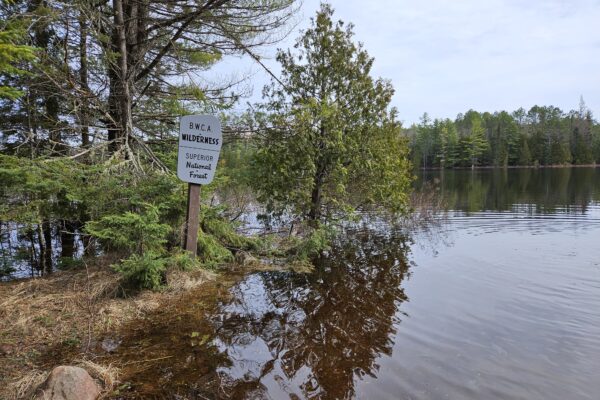
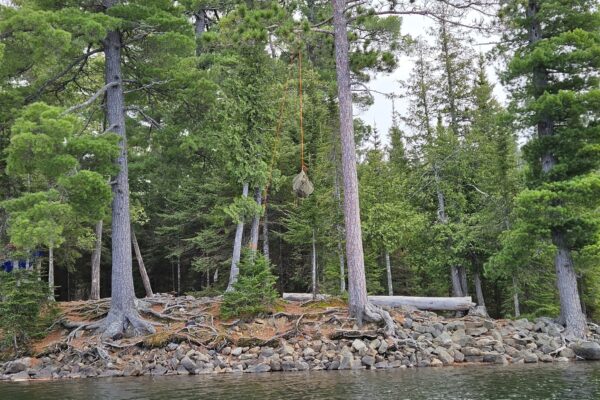
Boundary Waters Canoe Area Wilderness | Photo by Kalli Hawkins
Minnesota Senator Amy Klobuchar has publicly opposed the bill. In a statement to WTIP, Sen. Klobuchar said, “I oppose Senator Lee’s bill, which would allow harmful development in federal wilderness areas, while also requiring the government to waste resources that could be put to better use elsewhere. Instead, we should pass Senator Smith and my bill to support law enforcement, firefighters, infrastructure improvements, and search-and-rescue operations in the federal forest and wilderness areas.”
Illegal border crossings along the U.S.–Canada border occur far less frequently than those along the southern border with Mexico, according to U.S. Customs and Border Protection data. The remote landscape, dense forests, and harsh weather along Minnesota’s northern border create significant obstacles for anyone attempting to cross from Canada into the United States.
On Nov. 4, the Grand Forks Sector of U.S. Customs and Border Protection held a news conference in Warroad, Minn., to discuss illegal border crossings along the northern border and to showcase equipment used by law enforcement to patrol the border. During the news conference, CBC reported that Scott Garrett, the chief patrol agent, stated that illegal crossings from Canada into the U.S. have dropped by about 60 percent compared to the previous year.
The Grand Forks sector is responsible for 861 miles of the international border stretching across North Dakota and Minnesota.
According to CBC, Garrett stated that citizens from Mexico, India, and Romania comprise the three largest groups of individuals crossing the U.S. border illegally within the Grand Forks Sector.
With the ongoing government shutdown, progress on the bill has been slow. The next Senate Committee on Energy and Natural Resources hearing has not been scheduled yet.
Kalli Hawkins November 7, 2025