


Trail Time – Turtles & Bumblebees
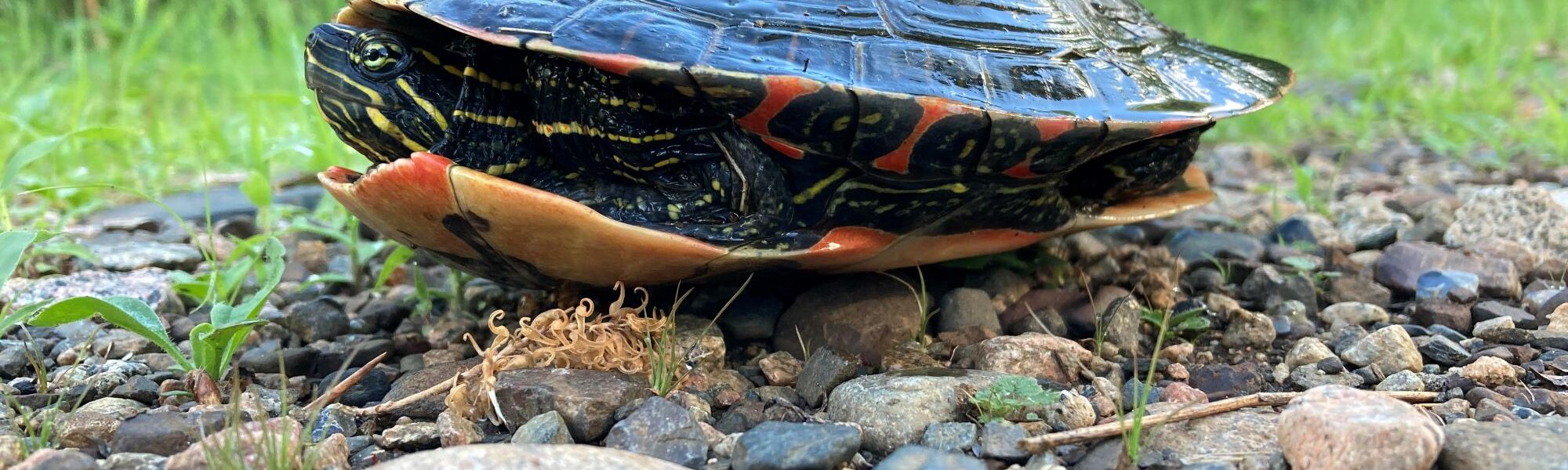
Now that it’s sunny and warm on the Gunflint Trail, you might see little hard shelled creatures sunning themselves on logs or rocks in slow-moving streams or close to a lakeshore. Or you might spot a little head poking out of water and you wonder: is that a stick or a turtle? It might be a Painted Turtle. Sometimes they’re called “mud turtles,” since they spend their winters under the ice, burrowing into the mud.
Their head, neck, feet and body are black with yellow stripes. The upper part of a turtle shell is called its carapace. The underside is called the plastron. They’re connected by a bony ridge. The kind of squarish shapes on a turtle’s shell are called scutes. The scutes are made out of keratin, like in other animals’ horns or beaks or like our own fingernails. The carapace of a painted turtle can be black to dark green or olive green or sometimes brown. It’s shiny and smooth. The plastron ranges from vibrant red to orange with a variety of black patterns in it, like an ink blot. They are very beautiful creatures.
The latin name for the painted turtle is Chrysemys picta. The Anishinaabemowin for painted turtles is Miskwaadesi. In the spring, mud turtles come to land to lay their eggs. I watched a large painted turtle lay her eggs at a portage in the Quetico; another time my younger daughter and I watched a snapping turtle lay her eggs in our Boundary Waters campsite. Once I was camping with some wrong-headed people who decided to “help” the painted turtle. That is usually a bad idea because the turtle knows better than us how to find the right place, how to dig a hole to lay her eggs in, and how to cover it up properly without crushing the eggs. Occasionally you can come across a turtle nest that has been dug up by a hungry animal and there are pieces of shells lying around. Turtle eggs kind of look like ping pong balls to me and the shell feels like fragile leather.
Painted turtles cross roads to get to water sometimes, so it’s a good idea to be on the lookout when you’re driving. It’s okay to help a painted turtle cross the road to bring it to safety; just make sure that you are safe in traffic. However, first determine that it is a painted turtle and not a snapper! Snapping turtles are much bigger and are mostly a greenish brown all over. They don’t have colors on them the way a painted turtle does. Also, their heads are a different shape. The snapper has kind of a beak and very powerful jaws. One day on the Gunflint Trail I came across a snapping turtle that had been run over. I thought it was dead because (squeamish alert!) the guts were all over the road. But it was a big turtle and it seemed to me to be kind of a driving hazard. I hopped out of the truck and picked up a beefy back leg to drag it off the road. That’s when the turtle turned its head and hissed at me. I dropped it real fast. They can give you nasty wounds with those jaws!
We don’t see many turtles around our place since we are not very close to the water. What we do have though is lots and lots of berry trees that are just covered in blossoms right now. Most are wild, but I planted a Canada plum about 12 years ago and it bore fruit last year. The fragrance of its flowers is heavenly. Chokecherry, Pin or Fire cherry, Saskatoon and wild apple are all blooming right now. The bumblebees have been very busy in the evenings.
The first bumblebees you see in early summer are the queens after they have left their hibernaculum. That is name for their cozy hole in the ground — sometimes it’s a former mouse nest lined with grasses. Queens are the only bumblebees that over-winter in Minnesota, so in the spring they are busy eating nectar so they will be strong enough to lay eggs. The first eggs to hatch are the worker bees and they all have different jobs, like leaving the nest to gather nectar and pollen; tending and feeding the eggs; mixing nectar and pollen to make bee bread; guarding the nest from predators. Bumblebees don’t make the same kind of wax octagons to hold honey like honeybees do. They make little honeypots out of wax to store nectar in. Late in the summer the male drones hatch. New queens are hatched last. Their job is to mate with the drones. When drones leave the nest, they don’t come back. Drones don’t take pollen home. Their job is to mate with the new queens, which are next year’s queens who in turn will find their own hibernaculum and go into a kind of hibernation that’s called “diapause” or “torpor.” Sometimes you can see the drones on a cool early morning after they’ve slept in a flower all night. Since drones don’t have stingers, you can warm them in your hand and then they’ll fly away.
— Marcia Roepke


