Lightning determined to have sparked three wildfires in the Boundary Waters
Over the weekend, three wildfires in the Boundary Waters Canoe Area Wilderness were discovered during a routine fire patrol flight.
Superior National Forest officials have determined that the three separate wildfires were sparked by lightning during a storm that moved through the area on June 4.
The Tiger Fire, located between Tiger Bay and Boulder Bay on the east end of Lac La Croix, approximately 22 miles east of Crane Lake, is estimated to have burned one acre as of Monday morning.
Fire personnel used a large Chinook helicopter to make water drops on the Tiger Fire to reduce its intensity and prevent it from spreading. On Sunday, firefighters established a safe access route from the lakeshore to the fire area and constructed a small fire line around it.
The Tiger Fire was declared contained Monday morning, Superior National Forest officials said. There are no closures within the BWCAW due to this wildfire, although a few campsites near the fire may need to be temporarily closed for public and firefighter safety, officials said.
The second wildfire is the Loon Fire, originally called the Shell Fire when reported on Saturday afternoon. As of Monday morning, Forest Service officials said the estimated size is 10 acres. The wildfire is approximately 11 miles east of Crane Lake.
A Chinook helicopter was also used to suppress the Loon Fire, with a second, smaller helicopter making water-bucket drops to slow the fire’s spread and reduce its intensity. The fire is creeping and lightly smoldering.
“Ten firefighters were transported to the fire to evaluate access routes and develop options for direct extinguishment of the fire,” said Superior National Forest officials.
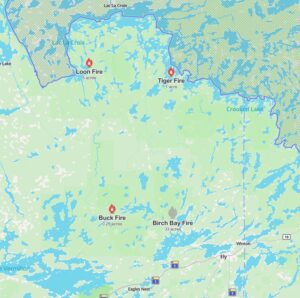
Three wildfires burning in the BWCAW | Graphic by Watch Duty
There are no BWCAW closures due to the Loon Fire at this time. Fire crews will continue to monitor the active wildfire.
The third wildfire is the Buck Fire, estimated to be about 1/4 acre as of Monday morning. The wildfire is farther south, approximately 12 miles north of Tower, Minn. The Buck Fire is reported to be smoldering. Fire crews will continue monitoring fire activity and use helicopters to drop water on the fire.
“The forecast for today includes the chance of rain, which could assist in extinguishing this fire,” said Superior National Forest officials. “Depending on the effects of the forecasted rain, firefighters may be transported to the fire to take direct suppression actions.”
There are no BWCAW closures due to the Buck Fire at this time. Fire crews will continue to monitor the active wildfire.
The public is also asked to stay away from all three areas. Any unauthorized unmanned aircraft system (UAS) flights threaten firefighter safety and wildland fire suppression efforts and are illegal near the fire area or the BWCAW, fire officials said.
A campfire ban went into effect in the BWCAW on Saturday, June 6. The Forest Service issued the campfire restrictions due to the continued dry conditions and high fire danger throughout the Superior National Forest.
Forest Service officials said the restrictions prohibit campfires and the use of coal- or wood-burning stoves within the BWCAW to reduce the risk of wildfire.
The order will remain in effect until June 30 unless conditions improve and the Forest Service rescinds or extends the order.
“The potential for wildfire is high across all ownerships in northern Minnesota at this time,” the Forest Service said in a Thursday news release. “It is extremely important that people are careful with any sources of ignition such as smoking devices, dragging chains, and recreational vehicles.”
Northern Minnesota received thunderstorms and precipitation on June 4, and again on Sunday and Monday. Meteorologists with the National Weather Service in Duluth said that more rain is forecasted for later this week.
WTIP spoke with a meteorologist with the National Weather Service in Duluth on Monday, June 8, live on North Shore Morning. Audio below.
Kalli Hawkins June 8, 2026