Walz takes executive action on copper-nickel mining near Boundary Waters
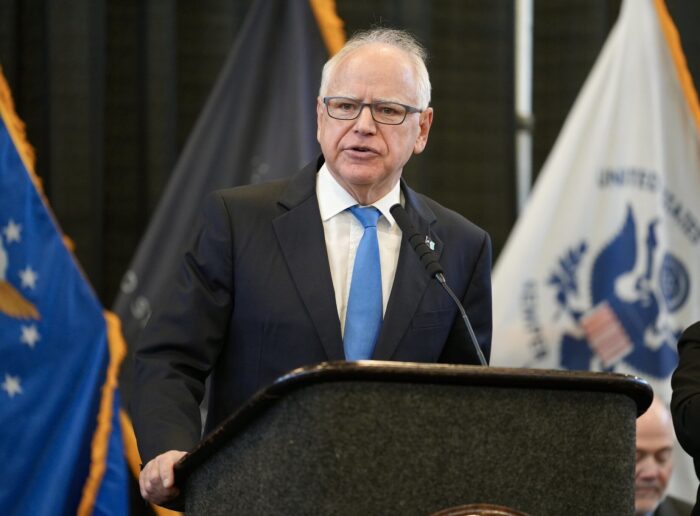
Gov. Tim Walz issued an executive order Tuesday that would prevent new state mineral leases for nonferrous mining operations in the Rainy River headwaters. The order also directs state agencies to halt environmental review and permitting work for nonferrous mining projects in the area while litigation over Minnesota’s nonferrous mining rules remains pending.
The executive order directs the Minnesota Department of Natural Resources not to participate in federal environmental reviews for nonferrous mining projects in the Rainy River headwaters. It also directs the agency to review existing leases in the area and “strictly enforce compliance with the terms of those leases to the fullest extent of the law.”
The Boundary Waters Canoe Area Wilderness is downstream from portions of the Rainy River headwaters, an area that has been at the center of a long-running debate over copper-nickel mining.
“I’m using my executive authority to ban nonferrous mining in the Boundary Waters,” Walz said in a social media post. “As far as my administration is concerned, the fight for the future of the Boundary Waters is over. The verdict is in. The decision is made. We will protect this place.”
The Northeastern Minnesotans for Wilderness v. DNR case began in June 2020, when the organization sued under the Minnesota Environmental Rights Act, arguing that the DNR’s rules governing nonferrous mining were inadequate to protect the Boundary Waters Canoe Area Wilderness.
An independent decision-maker ruled against Northeastern Minnesotans for Wilderness in April. According to the DNR, both Northeastern Minnesotans for Wilderness and Twin Metals Minnesota LLC subsequently requested review by the Second District Court of the DNR’s decision.
The executive order was welcomed by conservation advocates who had faced a significant setback after Congress used the Congressional Review Act in April to overturn a Biden administration mineral withdrawal that restricted mining on federal land in the watershed.
“Governor Walz just stood up for Minnesota, for Minnesotans, and for the Boundary Waters,” Ingrid Lyons, Executive Director of the Save the Boundary Waters said in a news release. “The Federal Government sold out our canoe country earlier this year by stripping away protections that took hundreds of thousands of Minnesotans’ voices and years of work to secure, all while ignoring science and the will of the public. Tribal nations weren’t even in the room.”
Several federal and state lawmakers representing Cook County have supported efforts to allow mining development in the region. U.S. Rep. Pete Stauber introduced the congressional resolution to overturn the Biden administration’s mineral withdrawal. After President Donald Trump was elected in 2024, state Rep. Roger Skraba and state Sen. Grant Hauschild wrote to then-President-elect Trump asking him to consider reversing the withdrawal.
Hauschild criticized Walz’s executive order.
“I strongly disagree with Governor Walz’s decision to ban non-ferrous mining in the Rainy River Watershed. A decision this significant to the people of the Northland should not be made through executive order by a Governor who leaves office in a matter of months,” Hauschild said in a statement following the executive order. “My constituents are sick of executive overreach by people who no longer feel accountable to the voters or the legislative process, whether that’s in St. Paul or in Washington. In my four years in the Senate, a mining ban never moved through the legislative process or was considered.”
The proposed Twin Metals copper-nickel mine would be located outside the Boundary Waters but within its watershed. Opponents of the project argue that pollution from mining operations could travel downstream and harm the wilderness.
Mining supporters argue that modern mining technology and environmental safeguards would allow nonferrous mining to operate without unacceptable risks to the environment.
WTIP previously produced a community conversation examining the debate over copper-nickel mining and the Boundary Waters Canoe Area Wilderness. That conversation is available below.
Josh Hinke August 18, 2026