Canada set to announce retaliatory tariffs as U.S. trade tensions rise
Canada will announce retaliatory tariffs against the United States on Tuesday as relations between the two countries deteriorate.
President Donald Trump told Canadian leaders to “fall in line” or face consequences worse than existing tariffs, while Prime Minister Mark Carney accused Washington of trying to subordinate Canada.
Trump threatened new 50% tariffs on Canadian vehicles, auto parts and steel, while Carney said U.S. trade demands showed Washington wanted to “destroy our major industries,” including autos, steel and aluminum.
Carney said earlier Monday that Canada may need to move away from matching U.S. tariffs dollar for dollar and instead use more targeted retaliation aimed at protecting Canadian workers and businesses.
“An attitude at the negotiation table that Canada is a subsidiary of the United States” is “not something we’re going to accept,” Carney said.
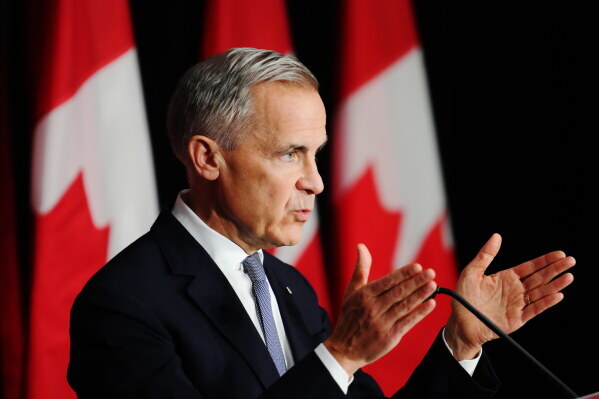
Prime Minister Mark Carney speaks about Canada’s response to new U.S. tariffs during a news conference on Parliament Hill | Associated Press
The escalating trade dispute could have implications closer to home in Minnesota and across the northern region, where businesses rely on trade with Canada and Canadian visitors.
Canada was Minnesota’s largest export market last year. The state exported $5.6 billion in goods to Canada, representing 24% of the state’s total goods exports, according to data from the Office of U.S. Trade.
U.S. Sen. Amy Klobuchar, D-Minn., who is co-chair of the Canada-U.S. Inter-Parliamentary Group, said in a Tuesday statement that the tariffs are raising costs and increasing uncertainty for families, farmers, workers and small businesses.
“Canada is Minnesota’s top trading partner and our economies and communities are deeply connected,” Klobuchar said.
The Canada-U.S. Inter-Parliamentary Group was established in 1959 as a forum for U.S. members of Congress and Canadian parliamentarians to discuss policy concerns and build bilateral cooperation. Klobuchar serves as co-chair alongside Sen. Kevin Cramer (R-ND).
Steeper tariffs raise costs for businesses — and almost always trickle down to households in the form of higher prices.
The trade dispute comes as Cook County and northern Minnesota businesses already face a difficult tourism season following July wildfires. A recent survey found July sales were down an estimated $9.4 million from the same month last year, with businesses citing wildfire-related cancellations and fewer visitors.
Canadian visitors are another important part of the region’s tourism economy, raising concerns about whether continued tensions between the two countries could further discourage cross-border travel.
In 2025, amid U.S.-Canada tariff and trade negotiations, businesses near the U.S.-Canada border, such as Ryden’s Border Store and the Grand Portage Lodge & Casino, were impacted and saw a decrease in Canadian visitors.
The auto sector is especially important to Ontario, the center of Canada’s vehicle manufacturing industry. Plants and suppliers in Ontario are tightly integrated with factories in Michigan and other U.S. states, with parts routinely crossing the border multiple times during production.
Automakers including Ford, General Motors and Stellantis operate major assembly plants in Ontario, and the wider supply chain supports tens of thousands of jobs. Trump’s new threat of a 50% tariff on Canadian vehicles and parts puts that sector directly at the center of the escalating dispute.
The Associated Press contributed to this report.
Kalli Hawkins August 25, 2026