House passes resolution to overturn Boundary Waters mining withdrawal
The U.S. House of Representatives passed Joint Resolution 140 on Wednesday evening by a 214-208 vote, with one Democrat and one Republican crossing party lines. The resolution now moves to the Senate, where it would require a simple majority before heading to President Donald Trump for consideration.
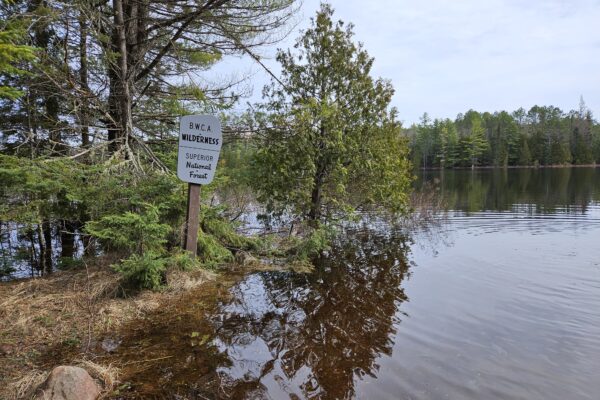
If signed into law, the resolution would overturn Public Land Order 7917, which enacted a mineral withdrawal in 2023 and ended federal leases held by Twin Metals. The company has been exploring a proposed copper-nickel mine in the Rainy River Watershed, several miles north of the Boundary Waters Canoe Area Wilderness.
”Today, those who voted in favor of HJR 140 voted to sell out American public lands to foreign interests,” said Ingrid Lyons, Executive Director of Save the Boundary Waters. “This bill sacrifices America’s most visited Wilderness for the benefit of a Chilean company that sends its concentrates to China. Now, we look to the Senate to protect the Boundary Waters, precedent, and public lands across the country.”
The resolution, introduced by U.S. Rep. Pete Stauber of Minnesota, invokes the Congressional Review Act to undo a public land order — an approach environmental advocates have described as unprecedented. Lyons previously told WTIP that the use of the CRA in this context departs from longstanding congressional practice.
“I’m thrilled the House has passed H.J. Res. 140 to repeal Biden’s illegal mining ban that directly threatened our way of life,” Stauber said in a press release. “Growing up in the Northland, I’ve seen firsthand how these radical policies kill jobs and hurt families.”
Twin Metals is a subsidiary of Antofagasta, a Chilean mining conglomerate. Reuters reported last year that the company agreed to have its copper processed at Chinese smelters at no cost — a record low for the industry — with the refined copper then sold on the global market by China.
“The passage of this bill in the House is a disappointing sign that our elected officials sided with a Chilean mining conglomerate instead of America’s outdoor community and are willing to risk our most cherished public lands for even the smallest chance of turning a profit,” said Lukas Leaf, Executive Director of Sportsmen for the Boundary Waters said in a statement shortly after the vote. “Members voting for this CRA placed a foreign mining project above the hunting, fishing, paddling, and outdoor community of the United States.”
Mining advocates praised the vote as an initial step toward restoring access to mineral resources. The National Mining Association released a joint letter Wednesday signed by nearly 150 organizations supporting renewed mining access in Minnesota.
Ryan Sistad, Executive Director of Better in Our Backyard, told WTIP in a statement, “The Range has been overdue for an economic comeback, and the resolution being voted on today has real potential to help deliver it—while strengthening America’s national security at the same time. “
The debate included multiple Minnesota representatives. Stauber spoke in favor of the resolution, while Representatives Betty McCollum and Kelly Morrison opposed it. Stauber emphasized that he represents the district home to the Boundary Waters.
“It won’t surprise you that the representative from that area supports this resolution,” Stauber said during floor debate.
“Today’s congressional House vote highlights the extreme gap between Stauber and his constituents,” Clare and Dan Shirley of Sawbill Canoe Outfitters told WTIP. “With our federal government more interested in giving handouts to foreign billionaires, it’s time for Minnesotans to stand up and protect these lands ourselves.”
The lands required for Twin Metals’ previously proposed mine are split between state and federal ownership, meaning approvals from both governments would be required for the project to move forward. If the federal withdrawal is reversed, it could increase pressure on the Minnesota Legislature to enact its own protections. With slim Democratic majorities in both chambers, however, such legislation would face significant hurdles.
“Today’s vote affirms that science and process – not shifting politics – should guide mine permitting,” said Julie Lucas of MiningMinnesota. “Minnesotans can safeguard our environment while supplying the minerals essential to grid reliability, electric vehicles, and national security. We’re ready to do the work, meet the standards, and deliver responsibly mined minerals for Minnesota and the nation. We urge the Senate to follow suit as soon as possible.”
Josh Hinke January 21, 2026