New statewide CWD surveillance plan will reach northeast Minnesota in 2028
The Minnesota Department of Natural Resources is expanding its approach to chronic wasting disease monitoring as part of several changes coming to the 2026 hunting season and years ahead.
The DNR recently released its 2026 hunting and trapping regulations, which include updates to electronic licensing, deer hunting regulations, waterfowl rules and a new four-year statewide rotational surveillance plan for chronic wasting disease, or CWD.
Under the new plan, Minnesota will be divided into four quadrants. Each year, hunters in one quadrant will be required to have all deer harvested during firearms opening weekend that are one year old or older tested for CWD.
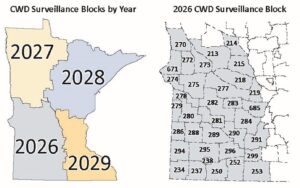
Graphic by Minnesota DNR
The mandatory testing schedule begins in southwest Minnesota in 2026, followed by northwest Minnesota in 2027, northeast Minnesota in 2028 and southeast Minnesota in 2029.
The DNR says the expanded approach is intended to provide a more complete picture of where CWD exists across the state.
“Recent detections of CWD in new areas and endemic status in the southeast core make a broader approach necessary for both disease management and efficient use of resources,” said Patrick Hagen, DNR wildlife disease response coordinator.
CWD is a fatal neurological disease that affects deer, elk and other members of the cervid family. The disease, has been prevalent in various cervid species across the U.S. and other countries since the 1960s. It is caused by abnormal proteins called prions.
CWD has been detected in parts of Minnesota, including areas of central and southern Minnesota, but the northeast Arrowhead region has remained without a confirmed case.
Hagen said previous surveillance efforts focused primarily on areas where CWD had already been detected or where the risk of spread was higher.
“While our past approach to sampling near areas of known disease has successfully monitored CWD spread in risk areas, nearly two-thirds of the state hasn’t had a targeted surveillance effort in more than 20 years,” Hagen said.
Although CWD testing will only be mandatory for the southwest quadrant for the upcoming 2026 deer hunting season, the DNR provides several free and convenient ways for hunters to get their deer tested statewide. Hunters can order a mail-in kit prior to opening weekend, visit a staffed or self-service sampling station, or visit a taxidermist participating in the partner sampling program.
The DNR also announced changes to how hunters can handle deer carcasses harvested within CWD management zones.
Beginning this fall, hunters will be allowed to move whole deer carcasses out of CWD management zones if the remains are later disposed of through a refuse hauler, landfill or meat processor. Hunters who harvest a deer on private property may also leave the carcass on that property with permission from the landowner.
Previously, hunters were required to quarter deer before removing meat from a CWD management zone or wait for a negative test result before moving a whole carcass. One regulation that will remain in effect for deer harvested outside of Minnesota is that the deer must be quartered before being imported into the state.
With the new disposal rules, the DNR is ending its dumpster program. DNR-provided dumpsters for deer processing remains will no longer be available beginning in fall 2026.
“We do want people to be aware that we are not offering DNR-provided dumpsters this year for butchering remains,” Hagen said. “Coupled with the change, the new carcass disposal rule will give hunters more flexibility in handling and transporting their deer while promoting safe disposal methods.”
The 2026 Minnesota hunting and trapping regulations are available through the DNR website, and hunting and trapping licenses go on sale Saturday, Aug. 1.
Kalli Hawkins July 29, 2026