2025 saw decade-high amount of venison donated by hunters to food shelves
2025 was a banner year for food banks that participate in the Hunter-Harvested Venison Donation Program. Almost 14,000 pounds of venison were donated last year, marking a decade-high rate of participation in a program that aims to provide additional protein to those facing food insecurity with the help of the state’s hunters.
Since 2007, the Minnesota Department of Agriculture (MDA) and the Minnesota Department of Natural Resources (MN DNR) have partnered with hunters to provide venison to a network of meat processors and food banks across the state.
Meat Inspection Supervisor Jennifer Stephes works with the Hunter-Harvested Venison Donation Program on the MDA side of the partnership. She told WTIP that while the MN DNR has facilitated a variety of game meat distribution programs in the past, the MDA has been a partner in the venison donation program to help ensure the safety of the donated meat.
Stephes explained that the initial concern that got the MDA involved with the venison program was the possibility of lead contamination of deer shot with lead bullets. Through the program, all donated venison is x-rayed to detect any lead fragments. For deer harvested in mandatory Chronic Wasting Disease (CWS) testing areas, the program also ensures that all donated meat has tested negative before it is sent to food banks.
For hunters who are choosing to donate a deer they have killed, they would field dress the deer as usual. After that, hunters bring the carcass to an MDA licensed meat processing facility. If the deer was harvested in an area where testing for CWD is mandatory, the processor would likely wait to do final butchering until results were available, according to Stephes. All venison that is donated through the programs is sent to food banks in either whole muscle or ground form.
Hunters from any part of the state can opt to donate a deer, and Stephes said that there are licensed processors across the state who will take wild game as part of the program. She added that the program aims to return venison harvested in a particular area back to nearby communities.
Stephes said that the decision has been driven by both hunters and food banks. She said hunters have often requested that venison from the deer they harvest be distributed in their own communities, and that food banks in areas with a lot of deer hunting have frequently inquired about the program. For residents of the Arrowhead, Stephes said that most deer harvested in the northeast corner of the state, distribution is done through a food bank in Duluth.
Participation in the program has varied over recent years. According to data reported by the MDA, the amount of venison has fluctuated significantly since 2019. The program saw particularly high participation in 2025, when the program collected 13,883 pounds of venison from 403 deer. That was up from a recent low of 7,371 pounds donated in 2022.
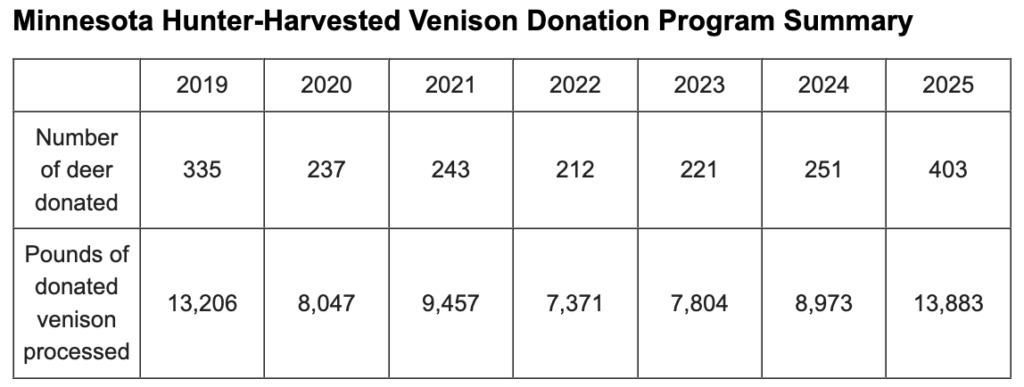
Stephes said that pinpointing a single reason for the changes in participation can be difficult, though she did suggest some things that could have contributed to the fluctuations.
During the Covid-19 pandemic, Stephes said that not only were many people not participating in their usual activities, but the flow of work in the meat processing industry was also disrupted. She said that as many large processors were unable to operate, smaller processors in the state were inundated with jobs from beef and pork producers, and were unable to take game meat at the same time. With more typical conditions restored, Stephes said there has been higher participation from producers.
Another major factor, according to Stephes, is participation in special hunts organized by the DNR. Special hunts include those aimed at managing population in areas impacted by CWD, or in urban areas where deer can be a nuisance to property owners or a danger to drivers.
For those looking to participate in the program, Stephes said there is information for hunters, processors, and food banks on the Hunter-Harvested Venison Donation Program website.
On the consumer said, Stephes said she often hears from food banks or their visitors, who are excited to have venison on the shelves. “I think that is the most rewarding thing, is to know that people really appreciate it,” She said. “And, you know, oftentimes we can’t thank the hunters because they’re kind of anonymous by the time we see the product, but we’re very grateful for our hunters that are willing to donate their deer and harvest these deer.”
Kirsten Wisniewski April 5, 2026