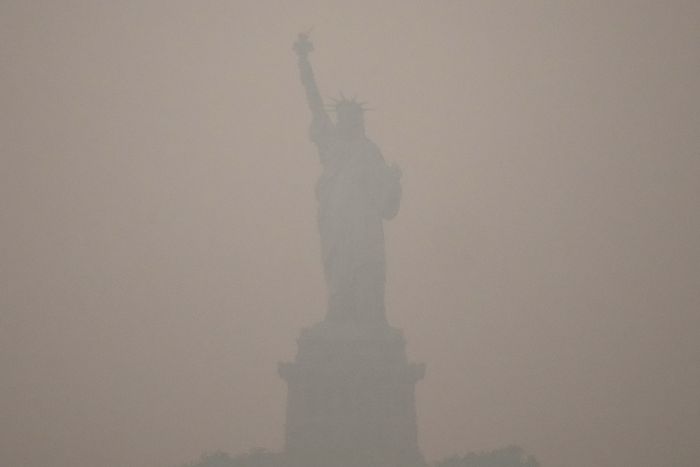
Wildfire smoke spreads across U.S., affecting multiple states and cities
The smoky skies and hazardous air quality that have plagued Cook County since Tuesday began to spread across the United States.
Heavy, pungent wildfire smoke darkened skies in the U.S. on Thursday from the Great Lakes to parts of the East Coast, reducing visibility and prompting warnings that breathing the air outside could be dangerous.
Officials in many cities urged residents to stay inside or wear masks outside as air quality reached unhealthy to hazardous levels, meaning it’s unhealthy for anyone, regardless of health conditions. A lingering high pressure system has trapped the smoke close to the ground, said Steven Freitag, a National Weather Service meteorologist in Detroit, where air quality was among the worst in the world for major cities.
“Sure enough, it arrived in force here and it’s really pretty extreme levels,” said Freitag, who noted that visibility in some areas was reduced to a half mile.
Microscopic particles can lodge deep in the lungs and enter the bloodstream, leading to heart and lung problems and contributing to other long-term health issues.
The air stinks and the sky glows yellow in some places
All of Michigan and much of Minnesota were under the hazardous air quality alert that Cook County resident first experienced on Tuesday. In the Chicago area, air quality ranged from very unhealthy to hazardous.
National Weather Service meteorologist Jake Petr said even if winds from the northwest clear skies as expected later this week, the smoky air could keep returning until the fires are out. That could take months, until it snows in Canada and northern Minnesota, officials have said.
Bill Ostrowski, 76, wore a mask as he walked through downtown Chicago, where wildfire smoke shrouded skyscrapers. “It stinks. It’s not a good sign when you wake up in the morning and you can smell the air,” said Ostrowski.
In St. Paul, Minnesota, the sky was “glowing yellow,” said Brent Williams, head of the soil, water and climate department at the University of Minnesota. The area “could be looking at weeks to months of continued smoke and flare-ups off and on as the winds blow in different directions,” he said.
A study published this year found that long-term exposure to tiny particles from wildfire smoke contributed to an average of 24,100 deaths a year in the lower 48 states. Long-term exposure can make existing health problems worse and lead to a range of chronic and deadly issues, including respiratory illness, cardiovascular and neurological diseases, and premature death.
New York City cancels activities and hands out masks
In the New York City area, a thick haze tinged the morning sky orange and yellow and partly obscured Manhattan’s skyline.
City officials opened cooling centers as health officials urged New Yorkers to limit strenuous and prolonged outdoor activities. The city’s schools, parks and other agencies moved activities indoors, rescheduled events and adjusted operations. State officials distributed tens of thousands of face masks at transit hubs and other major locations.
Gwen Moseley, 65, was among the first patrons at Rosedale Library in Queens to take advantage of the free masks, saying she’s on the road much of the day working as a therapist for children with autism.
“Who wants to be breathing this? It’s not healthy,” Moseley said as she waited to meet a young client. “When I’m out walking, I can feel the scratchiness in my throat.”
Smoke eased a bit but was expected to thicken again by late afternoon or evening, possibly lasting overnight, weather service meteorologist Maureen Hastings said. She said it might move south for a while on Friday but return at night.
The state Department of Environmental Conservation warned that there was a potential for temporary spikes of “very unhealthy” air quality from Buffalo in the state’s western corner to Rochester by Lake Ontario, Syracuse in the central region and down to the greater New York City area.
Philadelphia officials urged people to avoid strenuous activity and stay inside or wear N95 or KN95 masks outside.
“Today is not the day to start your marathon training plan,” said Dr. Palak Raval-Nelson, the city’s public health commissioner.
Minnesota fires are spreading
In Minnesota, forest rangers on Thursday combed a remote wilderness area for anyone who might still be there days after wildfires led to its closure.
Officials closed the Boundary Waters along the U.S.-Canada border on Tuesday. At the time, 6,000 to 10,000 people were inside, but Superior National Forest staff estimated Wednesday that they’d reached 90% of them, said Karen Harrison, a spokesperson for state and federal agencies involved in the response.
She said Thursday that smoke is making it difficult for helicopters to fly and that fires are spreading despite firefighting efforts.
“There will be fire on the landscape until fall, and some fire will be burning until snow cover,” Harrison said.
The Royal Canadian Air Force successfully evacuated 11 Minnesota teenagers and four staff members Wednesday from wildfires in an Ontario provincial park about 175 miles (282 kilometers) north of the Minnesota border.
Rainfall brings fog and hope
Thunderstorms swept through Grand Marais and areas of Cook County this morning. The rain was followed by dropping temperatures and heavy fog through downtown Grand Marais.
Outfitters on the Gunflint Trail reported via social media they were seeing blue skies this morning after the rainfall.
The National Weather Service reported winds “may give much of the Northland a bit of a break by this afternoon and evening.” Though they also reported that more smoke could move in Saturday.
The Associated Press contributed to this article.
Josh Hinke July 17, 2026