Wildfire experts urge proactive forest management as fire risks grow
In the wake of July’s lightning-caused wildfires, advocates for fire safety are working with officials on a solution that might seem unexpected: more fire.
Fire is a natural part of the boreal forest ecosystem, playing an essential role in its health and regeneration. These forests are adapted to fire, and some species depend on it to regenerate.
“Fire has been very diverse on this landscape and has been present through a combination of lightning strikes and also intentional ignitions by indigenous people who have lived here for hundreds and thousands of years,” Abby Andrus of Dovetail Partners told WTIP.
Dovetail Partners is a nonprofit organization that provides information on the environmental impacts and trade-offs of land management decisions. Part of its work in Minnesota’s Arrowhead region focuses on wildfire resilience and fire ecology.
“Historically, a lot of wildfire resilience has just focused on fire suppression and saving homes,” Andrus said. “But we also need to be, when we have a moment and we are not in an emergency, broadening that conversation to talk about forest health and fire ecology in the place that we live, and how we can be proactive in preparing for fire.”
Dovetail Partners’ message echoes concerns raised by other forest ecology and wildfire experts interviewed by WTIP. The accumulation of forest fuels, combined with increasingly dry conditions, is contributing to more intense wildfires in the Superior National Forest.
Several factors have contributed to the buildup of combustible material, including forest management practices, decades of fire suppression, insect infestations and wind events. Historically, wildfire management has emphasized suppression, leaving fewer opportunities for fires to play their natural role in maintaining forest health.
Climate change is adding to those concerns, with warmer, drier conditions and reduced snowpack increasing wildfire risks in northeastern Minnesota.
“We have hotter, drier, windier springs. We have less snowpack going into those, and so there have been more frequent catastrophic fires. And that is our projection. Like that is where we’re headed, rather than a once every 10 or 20 year event is what we’re anticipating looking at going forward,” Dovetail Partners Project Director, Teresa Floberg, told WTIP.
Using fire to manage the landscape is not a new practice. Anishinaabe people used intentional burning to manage forests and other landscapes long before the passage of the Nelson Act of 1889.
Today, prescribed burning allows fire managers to reintroduce fire under controlled conditions. Crews establish containment lines and conduct burns when weather and moisture conditions reduce the risk of uncontrolled spread.
Communities can also take steps to reduce their vulnerability to wildfires
“There’s a lot we can do, including mechanical thinning, creating fuel breaks and fire breaks around our communities, and prescribed fire to manipulate those conditions so that when an unplanned fire happens, there is less for it to consume,” Andrus said.
Andrus described a recent field trip to the site of a previous Minnesota wildfire that demonstrated the potential benefits of prescribed burning.
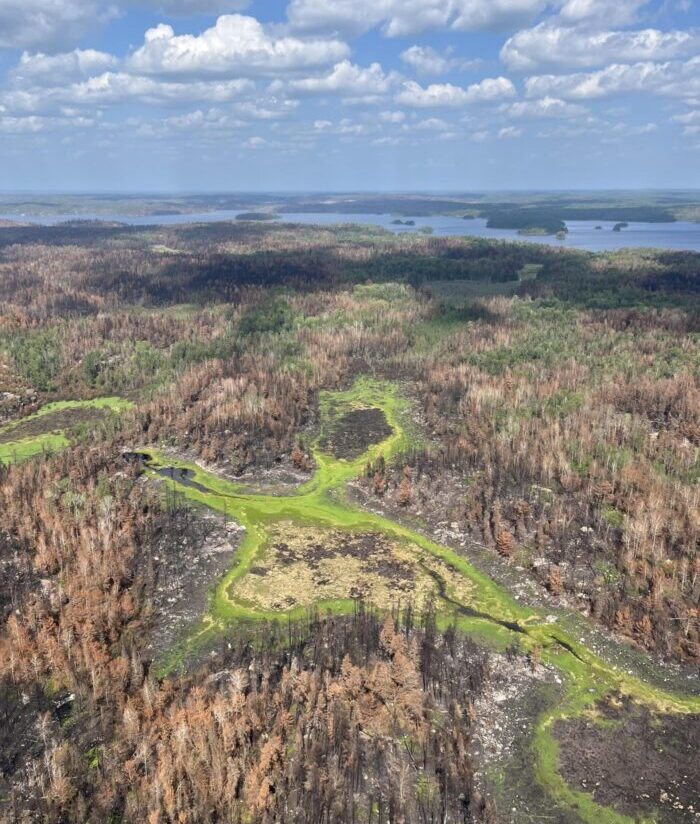
When the wildfire reached an area that had recently undergone a prescribed burn, its intensity decreased, allowing large, mature red and white pines to survive. In nearby areas that had not been treated with prescribed fire, the intense heat killed the trees.
“One of our goals is to have more conversations and implement and pave the way to implement more of that good fire, the fire that our fire-dependent forest needs,” Floberg said.
According to an analysis by Dovetail Partners using LANDFIRE data, approximately 542,000 acres would burn annually under historical fire conditions. By comparison, the organization estimates that 71,000 acres burned this summer, a season it described as “really intense.”
While Dovetail Partners and other organizations continue working to improve forest resilience, funding for those efforts remains uncertain.
“It is challenging when it’s one-time based on grant funding. When it’s not a sustaining program that has investments and options to rely on, it makes that long-term management challenging. You can’t just do it once and be done with Firewise as a community,” Floberg said.
WTIP spoke with representatives of Dovetail Partners about how communities and individuals can better prepare for wildfire season. Listen to the full conversation below.
Josh Hinke October 19, 2026